

The QLP Questionnaire: Gino Cosme
"Relationships don’t collapse because people don’t love each other. They often do because people don’t feel safe to be ordinary."


Email us at queerloveprojectsub@gmail.com to take “The QLP Questionnaire.”
Plus, find out how to submit your original personal essay to The Queer Love Project.
We pay our contributors, so your subscription and support is valuable! Thanks for reading.
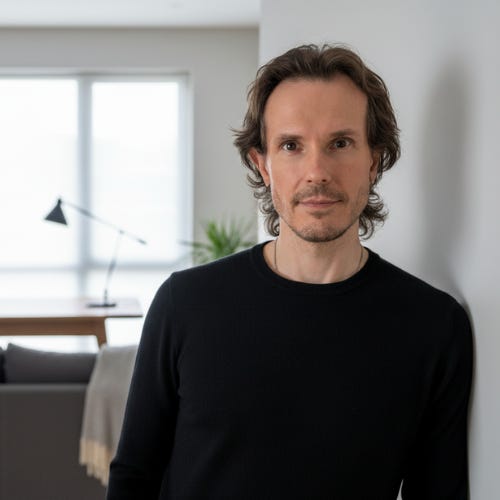
I’m a psychotherapist working exclusively with gay men across the globe, from London to Melbourne. After 10 years in digital marketing, observing how we curate our lives, I retrained to address the deeper gaps in our mental health care, specifically the exhaustion that comes from constantly translating oneself in a straight world. I've been doing this therapeutic work for over a decade now, running a practice rooted in queer reality rather than traditional frameworks from my base between the UK and Portugal.
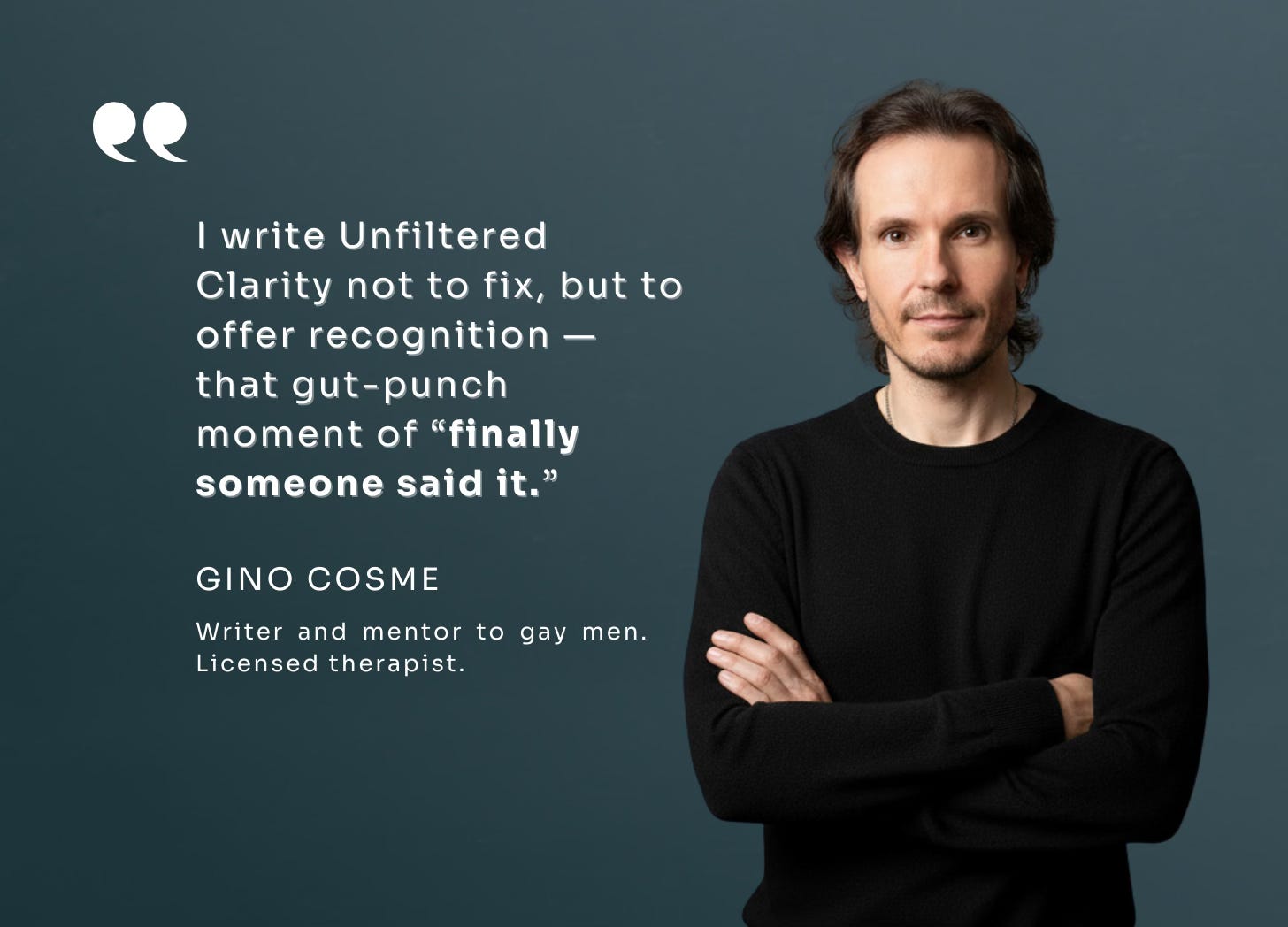
I also write Unfiltered Clarity on Substack, a weekly column where I write about the patterns we live but rarely discuss. My aspiration is to move beyond the therapy room, to create work that reaches gay men before they hit crisis, building a space where authenticity doesn't feel dangerous, and no one has to scan the room before they can breathe.
What is your age, where in the world do you primarily live, where did you grow up?
I am 47, live between London and Lisbon. A Portuguese national, I grew up in Cape Town, South Africa. Munich, London, and Shanghai followed until, since COVID, Lisbon and London.
How do you define yourself on the LGBTQ+ spectrum?
Gay, and I use he/him.
What is your relationship status?
Married. We’ve been together for 18 years.
Do you have an “ideal” relationship status?
Married, and focused on keeping it healthy and connected.
What is the biggest misconception about being single or in a relationship?
The biggest misconception is that relationship status equals emotional success. Single isn’t automatically lonely; partnered isn’t automatically secure. And neither guarantees real intimacy.
When was your first intimate moment (holding hands, kiss, etc.)? Was it with someone you liked? Did you feel pressured into it?
I was 17. It was with someone I thought I liked. I wouldn’t say I was forced, but I did feel pressure, partly from the situation and partly from my own need to “keep up.”
How would you define love? Is it the thing you work at for a long period of time? Or is it the strong feeling you feel for someone right from the beginning for no reason?
Not to sound too poetic, but love is what happens after the shine wears off and you still show up. It’s the long-term work of seeing someone clearly, letting them see you, and choosing repair over pride. It’s building trust in small moments, not declaring it in big ones. If the “right from the beginning” feeling is a spark, love is the slow burn that keeps the room warm.
When did you come out to family, friends and others for the first time?
I was 16/17. It coincided with the “first intimate moment” above. Coming from a devout Portuguese Catholic family, let’s just say it was the start of one of the most difficult periods of my queer life. Two decades of full family acceptance have been the result.
Did you have any LGBTQ+ role models as a child or teenager? What do you remember about images of same-gender or queer relationships or messages you gleaned?
No. Most of what I saw were stereotypes or cautionary tales. The message I absorbed was that queer love existed, but not safely or openly, so you kept it hidden and managed other people’s comfort first.
Do you have a chosen or found family?
Yes. mainly close friends and a few people who’ve shown up consistently over the years. They’re the ones I can be honest with without performing, and will answer my call at 2 am.
What is your relationship with your biological family (if any)?
I don’t feel fully met or deeply known there, despite our improved relationship. I feel my sexual orientation and my husband are accepted. But, over time, I’ve learned to keep realistic expectations, set boundaries, and put most of my emotional intimacy elsewhere.
Has race, ethnicity or cultural differences been a factor in who you seek out?
No. None of those were a factor in who I seek out—across all types of relationships, not only romantic.
What’s the most surprising thing you have learned about relationships from your perspective?
Relationships don’t collapse because people don’t love each other. They often do because people don’t feel safe to be ordinary. Most damage happens in small moments: the tone in a text, the micro-withdrawal after a misunderstanding, the habit of “keeping the peace” instead of telling the truth. I used to think chemistry and big conversations were the whole game. Now I think the real foundation is repair, consistency, and the willingness to stay present when your nervous system wants to run or perform. This applies to anything related to emotional and mental well-being.
Have you experienced heartbreak?
Yes, and looking back, it was a good thing. At the time, it felt like a loss. Later, I could see it was information. It showed me what I was settling for, what I was chasing, and what I actually needed to feel safe and valued. It hurt, but it also recalibrated my standards and made me more honest in how I choose people.
Do you have any moments of joy, happiness or pleasure that you can share about being in a same-gender or queer relationship?
Yes. The simplest joy is how ordinary it can be. Waking up next to another man without needing to explain anything. The shared look in a straight space that says, “Yep, we’re here,” then going back to choosing what to order for dinner like it’s the least dramatic thing. Laughing over stupid domestic stuff, fixing something in the house together, planning trips, disagreeing and repairing, then carrying on. There’s also a quieter pleasure: being with someone who doesn’t require you to translate your history. You don’t have to justify why certain family questions land sharply, or why safety is something your body checks for. You can just exhale, and that exhale is its own happiness.
Are there any things that standard heterosexual relationships have that you feel are out of reach or that you wish you had or could achieve?
Yes, a few. Not because gay relationships are lesser, but because the world still makes some things harder than they need to be.
The big one is ease. Straight couples often get to move through life without their relationship being “a statement.” They can hold hands without scanning the room, introduce a partner without doing a risk calculation, and assume basic social recognition almost everywhere.
And safety across geography. In some places, the dream is not romance. It’s just being able to exist as a couple without feeling watched.
This isn’t about wanting to be straight. It’s about wanting the same baseline of legitimacy and ease.
Have you ever been in a polyamorous relationship or would you like to be in a situation that doesn’t involve just two people?
No. It’s not my preference, though I respect that polyamory works well for some people.
What is your philosophy about relationships?
Love is sustained by emotional safety, shared values, and the willingness to repair inevitable small hurts. The goal isn’t to be “perfect together,” but to be honest together. To keep choosing each other without turning the relationship into a performance review. To protect the bond while telling the truth, even when it’s awkward. Healthy relationships feel boring in the best way: consistent, respectful, and real.
Any good/bad advice you received from a friend or queer elder?
Good advice: “Pick someone who’s kind when they’re stressed. That’s the real personality.”
Any advice you’d give to someone younger than you who thinks it’s impossible to find love?
Yes: stop seeking proof that you’re “lovable” and start looking for compatibility and emotional safety. Love isn’t a lottery; it’s mostly proximity, repetition, and choosing people who can do the basics: consistency, honesty, repair, and kindness under stress. If you keep dating those who spike your nervous system, you’ll confuse anxiety for chemistry and call it fate.
Don’t make your life a waiting room. Build friendships, routines, a body you feel at home in, work you respect, and a community that sees you. This makes you less available for crumbs and more likely to meet people capable of love.
It isn’t impossible. But it does require you to stop auditioning and start choosing.
BONUS:
We all need more inspiration. Recommend something that influenced or helped shape you significantly that you’d recommend to someone else.
Book: The Velvet Rage by Alan Downs. Not perfect, but it names the specific kind of shame many gay men carry even after “everything is fine.”
TV Show: It’s a Sin. This is gorgeous, devastating, and honest about grief, love, and the cost of being invisible.
Song: “Into My Arms” by Nick Cave & The Bad Seeds. Love without sentimentality. Just devotion, nerves, and reality.
 | A guest post by
|
Thanks so much for the wonderful advice.
Thank you so much - all of this resonates with me, too.