

Estrangeiro
Oh, how I miss his mushy heart!

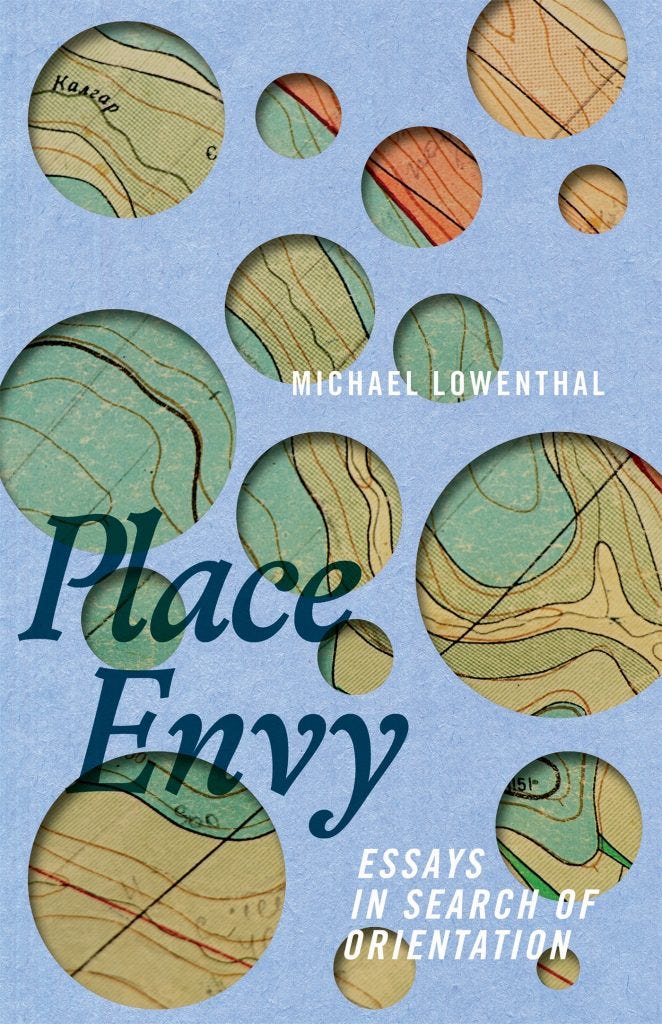
This is an excerpt from “Estrangeiro,” from Michael Lowenthal’s collection,
Place Envy: Essays in Search of Orientation, which is available for purchase.
I’d met Uílliam two years earlier, when I was in Brazil for an artists’ residency on an island off the coast of Salvador. Needing a break from my novel-in-progress, I had taken a ferry into the city one Friday night, having booked the cheapest hotel available. I was proud of having made the call in Portuguese, which I was trying to teach myself. My novel featured a Brazilian character, and I was here to dive deep into the culture.
The hotel wasn’t bad for sixteen bucks, but I was surprised by the mirrored ceiling, the porn on the toaster-sized TV. I decided to take it as a nudging from the fates. A deep cultural dive, sure—but on this night I would settle (fingers crossed) for sex.
If you’d asked me how this urge related to my home life, I might’ve claimed it didn’t: that was the point. My boyfriend, Scott, and I had been together for thirteen years; recently, we’d bought our first house. Sex was a source of tension for us—a rift about the link between the physical and the emotional—but Salvador, four thousand miles from Boston, made that problem distant. Hooking up with other guys was well within our rules. Tonight, I thought (leaning into the pun), I’d be scot-free.
I’d heard there was a back alley that housed a string of gay bars. After three circuits around the block, I found the guts to enter. The alley was packed: swishing queens, dykes in backward ballcaps, sweaty shirtless gym rats and surfers—Afro-Brazilians, almost all, bumping to a raucous axé anthem. Everyone seemed so unconstrained, all the more so for standing out in the street. My own stiffness felt like a failure of imagination.
I wanted a drink to hide behind, but all I saw were big bottles of beer shared by friends, and how would I buy one? I could find no waiters.
Then a shout in Portuguese: “You alone?”
I turned to find two guys in chairs against the concrete wall. One was chubby, with puggish eyes. The other, shockingly lean, had thick black hair and brown skin so smooth I was sure he’d never shaved. A single dimple flashed in his cheek. “So,” he tried again, “you alone?”
His youthful chutzpah made him almost painfully my type. I sat beside him and said, “Not anymore!”
His name was Uílliam, and his pal was Leo. He poured me some beer, then ordered another outsized bottle, dismissing my offer to pay. The book is on the table was the only English he knew—a line from a long-ago school lesson—and so we had to make do with my scanty Portuguese, learned from CDs I’d borrowed before the trip.
As Leo sulked (his love for Uílliam leaking from every pore), Uílliam and I vacuumed up facts about each other. Twenty-three, although he could have passed for seventeen, he had moved to the city that year, hoping to go to college and learn law. Hearing that I was thirty-eight and a university teacher, he nodded with apparent satisfaction.
“When I saw you,” he said, “I made myself a promise: if he comes by again, I’ll say something. Normally, I am not so brave.”
“Liar,” I said, and goosed his side.
“I’m shy!” he insisted unshyly. “A boy from the interior!” The town where he’d grown up, he said, was ten hours’ drive by bus.
His left forearm, smooth as his jaw, sprouted just one hair. I saw him not as a law student but as a cocky, moxie-for-miles newsboy in a classic film.
Uílliam bought another round, and I got up to piss. When I returned, he was standing, asking if I was ready. With Leo scowling, we hurried off, Uílliam bouncing along on his toes, as if overeager to greet the future.
At the hotel, I said I was sorry for its nature, but Uílliam—taking in the mirrored ceiling, the porn, a basket of rubbers and lube for sale—gave my shoulder a flippant punch. “When we grow old together,” he said, “we will always remember our first night!” He cackled at his own joke, and I was laughing, too, smitten by his easy confidence.
After sex, we studied each other. “Pele de mel,” he murmured, stroking my “honey skin.” I stroked his skin, too—a burnished-looking bronze—but I was too nervous to comment. I’d read a piece about Brazilians’ racial attitudes, including a list of one hundred and thirty-six variations of skin color. I wasn’t sure how to ask him how he identified.
I asked, instead, about his tattoo. Just beside his cock, in a Speedo-shaped patch of unsunned skin: a turquoise dolphin, caught in joyful leap. “What’s this color in Portuguese?” I asked. He said, “Turquesa.” Undulating his hips, he made the dolphin swim, and then we were laughing again, then kissing. Kissing him was like discovering I could breathe underwater, a blue infinity: I never wanted to surface.
In the morning, I woke up late for a meeting at the residency. Rushing to dress, I managed to say that I was living on Itaparica, an island out in the bay, at a remote artists’ colony with sketchy internet. “But here, take this,” I said, and wrote down my email.
“Email?” he said. “Seriously?”
Out on the street, he bussed my cheek, then bolted. Had I misread him? For all his charm, was he a “one and done”? I twinged. I was hopeless at shallow sex.
The next day, a staffer told me someone was out front, asking for a Michael: “Local guy. Doesn’t even know your last name.” What should she do, tell him to buzz off?
“No,” I said. “I think I know him.”
At the entrance, there was Uílliam, peering through the gate. My body felt like one big muscle, flexing with desire; at the same time, something in me unclenched. “Wow! How did you even find me?” I asked.
Uílliam flashed his single-dimpled grin and told the tale: riding the hourlong ferry to this unfamiliar island, hailing a kombi, then hiking for miles, asking strangers if they knew where “the foreign artists” lived.
The residency didn’t allow overnight guests, so we searched for a reasonably priced guesthouse. (I was paying, but he refused to let me get ripped off.) Our room stank of mildew under disinfectant. After we fucked, we were cuddling, watching a harebrained Nicholas Cage caper, when thunder punched the air, and rain poured down the insides of the walls.
“Now,” he said, “we will always remember our second night!”
I laughed, but his joke, this time, felt a bit less ludicrous. Drunk on hormones and novelty, I could picture a third night with Uílliam, a fourth . . .
Which was why I drew a line. I said I had a boyfriend.
“Of course,” he said. “All the guys I like the most are taken.” He sounded forlorn but not displeased to have his theory affirmed. He led me in a samba across the rain-drenched floor, stomping like a schoolboy in a puddle.
“Hooked up with any of the locals yet?” asked Scott.
We were Skyping, the next night. He sat in the kitchen, at our vintage dinette set, framed by walls we’d painted in a shade called Yellow Brick Road.
“Actually,” I said, “I did meet one guy.”
Scott was smiling, his strong jaw peppered with ginger stubble. “Details?”
What should I tell him of Uílliam? About his trek to the island, and how he’d grinned to see me again, as if I were the X on a map of hidden treasure?
“Totally up my alley,” I said. “Super, super skinny. Tiny ass.”
“Hot!” Scott said.
I waited to hear what else he wanted to know.
“Oh, speaking of tiny,” he said. “There was a baby rabbit in the front yard yesterday. But now it’s gone. I worry it got eaten.”
I was only half listening, squeamish at having described Uílliam so reductively. It felt unfaithful—to both him and Scott. But Scott hadn’t even asked if I would see Uílliam again. He could not imagine how I’d use someone like Uílliam to patch over the holes in our own love.
Scott was funny, brilliant, perennially impish—the person with whom I always wanted to leave any party, so we could gossip all the way back home. But in matters of sex we clashed, especially since his interest in me had fizzled.
For me, sex and love were strands tied together, the thrill cinching when both ends were pulled. For Scott (so he’d explained, trying to assuage me), they were roads that rarely intersected. Nothing turned him on as much as hooking up with strangers, with whom he felt unleashed. He loved me too much, he said, to do with me the things he did with them.
As a closeted teenager, I had ached with loneliness, scared I’d never find a man to love me. I could not have imagined the lash of this new loneliness, when Scott—the man who did love me—passed me over for strangers. It felt like an unresolvable mathematical riddle: the closer we got, the further away I would push his passion.
“Well, it’s getting late,” he said. The kitchen glowed behind him. “Really miss you!”
“Miss you too,” I said. “I’m homesick.”
The word resounded oddly. Seasick meant the motion of the sea caused you nausea; carsick meant a car made you ill. What did homesick say about your home?
Scott blew me a kiss, then leaned into the screen, nearer and nearer, until his face blurred.
The limit I’d set with Uílliam seemed somehow to free us; we burned through romantic fuel we had no incentive to conserve. At a gallery opening, we scoffed at the vapid art, then scored some coke and skipped out to the street, holding hands. We stayed in another love hotel, this time on purpose. On the beach, at dawn, we stood together pissing, merging our streams into the glinting surf. Even though it was April, he gave me a valentine: My heart is perfect because you are in it. He was unafraid to reveal his mushy heart and made this seem not maudlin but courageous.
And yet, the more couplish we got, the more doubts I had.
When we went out, I was acutely conscious of our differences: the almost-forty gringo, pudgy-bellied, sunburned, next to the boyish, dark-skinned Bahian. The city teemed with disparate pairs like us. Brazil, I’d read, was now the world’s top destination for sex tourism. Salvador had been the country’s colonial capital, the largest slave-trade port in the Americas, and it was impossible not to see vestiges of racist exploitation. Rich white foreigners came in search of Afro-Brazilian culture—the capoeira and Candomblé, the drumming and dendê oil—but some also came for “exotic” sex and “primitive” promiscuity. Millions of Bahians lived on only dollars a day, so plenty of locals were willing, for a fee, to go along.
Seeing those gringo–local couples always made me cringe: because I thought we were above them or because I worried we might not be? The night we’d met, Uílliam had bought our beers in the alley bar: not the typical act of a gold digger. (Unless—oh God, how could I be letting myself think this?—unless he had paid for those first rounds as a gambit, all the better to drain me dry later.) Since that night, I had gladly paid for everything, and Uílliam, though he seemed to go along just as gladly, asked for nothing more from me than fun and sex and friendship. But what if I hadn’t been paying? Would he still be interested?
Then at a club one night, a man rolled his eyes at us, and Uílliam must have felt my body tense. “Who cares,” he shouted over the music, “if some idiot thinks I’m just a rent boy? No one knows the truth of us but us.” Exultant, he mashed his hips on mine.
Did we see our truth the same? I suspected we both looked for escape: for him, from the limits of his life’s opportunities; for me, from the riddle of loving Scott.
I brought him to the residency, where we hung out with a Japanese artist who built “nonfunctional architecture” with light. Telling us we gave off an irresistible glow, she asked to photograph us by the sea. Uílliam wore a Speedo the same blue as the sky, the dorsal fin of his tattooed dolphin peeking above the waist. We lay together on a dock, his head against my stomach, and I imagined someone later (in Japan?) looking at our photos. What would they see? Something sincere, I hoped. Symbiosis.
The artist asked if Uílliam was often attracted to older men. Yes, he said, for as long as he could remember. Early on, disturbed by this, he had seen a shrink, but now he reveled in knowing what he liked. The only problem, he added, giving my wrist a yank, was that he fell for older foreigners—estrangeiros—who inevitably went back to their lives.
My wrist burned. Had he meant to yank quite so hard?
Since my mention of Scott, we had not revisited the topic. But then, on our last date—strolling arm in arm along the promenade at Itapuã—Uílliam asked: How old was he? What country was he from? I should have heard the fantasy in his questions: that I befriended young men and ferried them to better lives in America. But what I heard was jealousy, and I was floundering for answers when Uílliam interrupted: “Why do I do this thing? I fall in love with someone, knowing he has to leave, and then he does, and I am left alone.”
I could have said that I would feel lonely, too, even at home. But, of course, my home was solid: a house I owned, a partner. I said only, “I fell in love too.”
At the end of my residency—the weeks had felt like months, a stop-time honeymoon—Uílliam saw me off at the airport. He gave me a pillow to hug, its cover stitched with Mon Bijou, and a stainless-steel promise ring. Oh, how I would miss his mushy heart!
This is an excerpt from “Estrangeiro,” from Michael Lowenthal’s collection,
Place Envy: Essays in Search of Orientation, which is available for preorder.
 |
|
There’s something about these fleeting connections with would-bes and as universal an experience it can be it’s still deeply bittersweet. Thank you for sharing this with us.
Absolutely beautiful.