
How Lestat Changed My Life
Of all the people who could have articulated my sexuality—therapists, partners, me—it was a fictional vampire who gave me the right words.

Email us at queerloveprojectsub@gmail.com to take “The QLP Questionnaire.”
Plus, find out how to submit your original personal essay to The Queer Love Project.
We pay our contributors, so your subscription and support is valuable! Thanks for reading.
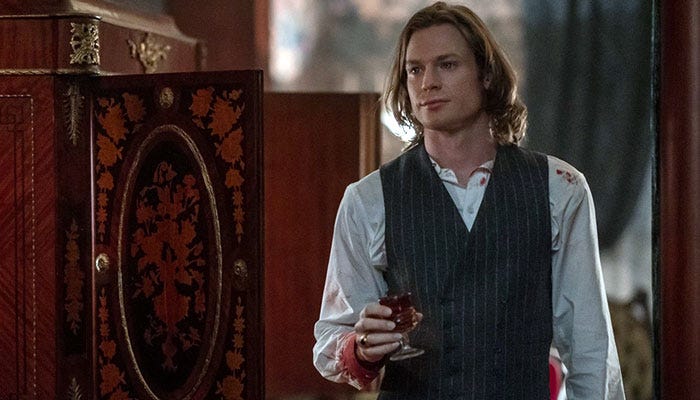
I was 36, watching the first season of AMC’s adaptation of Anne Rice’s Interview with the Vampire, when the bratty, charismatic pseudo-villain, Lestat (played by actor Sam Reid) argues with his partner Louis (Jacob Anderson) about their relationship.
In the scene, Lestat defends his interest in both women and men. Louis is understandably upset about Lestat’s flexible sexuality, given that they are two men living together in 1900s Louisiana. “Crimes against nature” (i.e., their entire relationship) was a felony at the time, punishable by huge fines and serious prison time. Not to mention that they were both fatally allergic to daylight, presenting a major problem if they were ever arrested.
“Queer, half queer, mostly queer, what is it?” Louis asks Lestat as the two vampires load a bloodless body into an incinerator.
“Non-discriminating,” Lestat slaps back.
Oh snap, I thought. It was an expertly avoidant, yet honest description.
In the next episode, they argue again after Lestat sleeps with a woman.
“Aren’t I enough?” Louis asks. Lestat laughs and embraces him, explaining the likely drudgery of their coming millenia of married life. “From time to time,” Lestat says gently. “I like a little variety.”
Boom: There it was—a phrase I could actually say out loud, about myself.
The dialogue was also a huge swing as far as adaptations go. Anne Rice’s original work never explicitly outlined Louis and Lestat’s sexuality, though their steamy intimacy is obvious to any reader with a pulse. Outright announcing the issue so early in the first season was a gift to a modern audience that reset the tone for the classic series.
I’m not knocking the veiled but totally epic source material. I grew up in the Deep South, where the books are set. There, even straight sex was seen as a private matter, especially in the 1970s-80s when the books were first published. By the time I came of age in the ‘90s and early 2000s, announcing one’s sexuality still felt unnecessarily gauche, if not dangerous.
Where I’m from, sex education started with hand-drawn information about eggs and sperm, projected on a screen in middle school health class. High school carried that vibe forward when an abstinence-only coalition made up of teachers and a group of upperclassmen called “the A-Team” came into science classes to hand out grotesque laminated pages about STDs. They spouted off catch phrases like Sex is a drug. Just say NO!
Or: Condoms don’t protect the heart!
What the teachers didn’t know was that the members of the A-team were the most promiscuous kids in school. I knew this intimately because I’d at least made out with most of them—and their girlfriends. Even though everyone involved was consenting and aware of the situation, a kind of magic occurred every time we hung out: the minute we were done hooking up, we went home, and the entire experience completely disappeared.
It’s not like we were making an effort to avoid it. It just ceased to exist. Life split into two worlds: the official story and the truth. For years, my official story was: I lost my virginity with my first serious boyfriend when I was 16.
The real story is that I had sex for the first time with three other girls in my bedroom, all of us trying to balance on an inflatable couch from the dELiA*s catalog. As hilariously awkward as it sounds, it was super fun. We repeated the experience often, usually atop less precarious furniture.
The real story had been deleted from my mind or body until I was 21, eight months pregnant and driving home from an unexpected reunion with one of those girls.
Before that reunion, I considered myself a prude. Definitely straight. I could count my (male) sexual partners on one hand. Then Mandy found me on social media and sent me a message telling me she was visiting San Diego, where I had recently moved. She invited me out for a drink.
I drove to a swanky hotel downtown to see Mandy for the first time in years. We’d both left our hometown after a hurricane tore through it the same year we graduated high school, and we knew little about each other’s lives since.
As I waddled into the lobby bar, I saw Mandy right away. She was striking, one of those women with a lioness vibe, even though she was dressed like a fifth grader on her way to church: pink cardigan, pale pants, KEDS, and a huge bow in her hair. I wore the only thing that could fit over my massive belly: a blue flowered muumuu, and the only boring flip flops I could squeeze over my swollen toes.
When she saw me, Mandy flew up and hugged me, hard. She touched my hair and told me I looked radiant. I told her she was a fucking knock out, as always. We both drank Shirley Temples and talked about our lives. I described the persistent morning sickness of the pregnancy that felt never-ending and my fears about the experience of childbirth. She told me about meeting her husband at church, how much she loved him, and how she was “revirginizing” herself before their marriage.
“You’re doing what now?” I said.
“Making myself a virgin again.”
“How do you actually do that?” I asked. “How long does it take?”
“It’s a process for sure,” she said with a laugh. “I’m so lucky. My fiance is so patient with me and my…urges.”
“Oh,” I said. “So ya’ll don’t hook up?”
She blushed. “He’s less experienced than I am,” she explained. “I think it makes him feel insecure. He says he’ll be ready to marry me when I’ve fully revirginized.”
“What about making out?” I asked. “Are you allowed to touch each other? Or second base? Third? The stuff we used to do?”
“What are you talking about?” she asked. She blinked. She looked truly curious.
“You know…with the other girls…” Even as I said it, I wondered if it was real, but as the seconds passed, the memories came rushing back,
Mandy shook her head a little and frowned, then smiled and laughed, like I was making a silly joke. “Praying helps, but it’s a process,” she said.
I drove away bewildered, but by the time I pulled into my driveway, I was pissed. “No!” I said into the Santa Anas blowing through my open windows. “That was real. That actually happened.”
I wanted to drive back to the fancy hotel and shake Mandy until she remembered. I wanted to fly back home to the small Florida town where we grew up, go back in time, and tell everyone in the science class the minute the A-team walked in the door. I wanted to claw at the wall of cognitive dissonance that had split my life in half. Why did I do that to myself? I wondered. And what does it mean?
I stewed in my car for another 20 minutes, then rushed inside to brush my teeth and immediately flopped into bed. I said nothing to anyone. I didn’t even know what I would say, or why it would matter to my fiance, my friends, or my family. Who cares who I slept with in the past? I kept thinking, but I also couldn’t stop thinking about it or asking that question. There was never an answer. Who is supposed to care?
Even if the word bisexual resonated with me—which it never has—it was barely part of my awareness. Pop-culture representations of queers/bisexuals was relatively nonexistent at the time. During the 2010-2011 TV season, for example, lesbian, gay, transgender, and bi characters—as a group—made up 3.9% of characters on TV. It was certainly less, six years before, when I was in high school. If I did build myself a time machine with the explicit purpose of announcing the sapphic truth of the student body who already called themselves the ‘04 Whores, what words would I actually use?
Hey everyone! The most popular girls you know would rather be playing with each other’s boobs than going on dates with the football players they’re considering marrying?
Not a great plan. And again, who cares if all those randos I’d probably never see again knew who I got naked with? I’d read coming out stories in zines and heard how important it was to the gay boys I knew, but this wasn’t that. When I rambled these musings to one of those boys after meeting with Mandy, he said, “Well, you can choose, right? So just choose to be straight, and you don’t have to worry.”
“I can’t choose!” I blurted out. “I just like who I like!” We were both taken aback. Apparently, I could only find ways to articulate my sexuality when someone else made assumptions about me.
As years passed, when I did find ways to articulate my sexuality, other people's responses mirrored his. They often said something to the effect of, So what? Most women are a little bit gay anyways. Plus an allusion to so-called “lesbian” porn.
What matters is that we had fun and cared about each other, I eventually determined. I made it my mantra. I chose to believe that Mandy’s denial of our experiences was what she needed to do to feel safe and welcome in the life she chose with her new husband. I’d been ignoring my own memories for years, so how could I blame her for navigating her timeline the way she needed to?
In the years that followed my meeting with Mandy, I felt ashamed for not having a clear idea of my sexuality. I didn’t think about Anne Rice’s universe of queer-ish vampires that I’d spent years devouring.
I didn’t realize that these books, more than any other media available to me, had painted a lush reality where one could move through the world loving people of all genders for who they were without ever committing to a category. In them, male vampires chase each other through space and time, calling each other beautiful, doting on each other’s eyes and lithe bodies and capacity for intimacy. They never name their desire as anything but desire, affection, love. The only labels they grapple with in the books are things like “monster” and “killer” because they drink other people’s blood to survive. They live in the shadows because they believe themselves to be villains due to that propensity for murder—not because of who they are attracted to.
The books showed me that a queer life could be as beautiful as a straight life. I didn’t realize, at the time, that reading these books during my formative years gave me a lush map for an adulthood where I prioritized my interactions with people over defending and defining the story of my own identity, over and over.
I’m not saying avoiding labels was the correct path, but like the characters in The Vampire Chronicles, I continued to enjoy a lifetime of luxuriously dancing around my own queer identity. I spent years believing that if we didn’t have a good reason to talk about it, why bring it up? The fact that my romantic interest is not tied to a person’s gender or biological sex has only felt like a relevant factoid to share in the moments when it was actually relevant—typically, intimate situations. Blame it on my autism or call me out for my persistent urge to avoid drippy conversations if there is any other feasible topic available.
Or maybe I’ve kept my sexuality mostly to myself because being bi or queer or pansexual or anything other than strictly gay or straight isn’t popular.
I did end up marrying the father of the baby I was pregnant with during that bizarre reunion with Mandy, but our relationship didn’t last. In the many years since, I’ve met straight guys who were afraid to date me because they thought I’d always have one hand in their bed, the other searching the empty space beside us for a stray vagina. I’ve dated women who actually hissed with disgust when they found out I’d also been romantically involved with men and might be again.
In my experience, people don’t think you’re real unless you can devote yourself to a clear label. I tried on the gamut, feeling the most comfy with a generalized queer than any other deterministic term, though bi is the label that more closely approximates my dating history. Regardless of how I identified myself, I’ve heard too-many times, “But who’s team are you on?” as if all the lesbians in the world are a monolithic softball league that I have to choose over straight women to legitimize any non-dudely love story I participate in.
And I’m not alone. In the United States, bi people make up the largest percentage of the LGBTQ+ community, but we explicitly “come out” less than any other group. I personally believe that’s because of the major backlash we receive when one group or the other feels betrayed when we “switch sides.”
Recently, Jojo Siwa and Billie Eilish experienced a social media hell storm when they started dating guys, even though they both had announced publicly that they were bi. Freddie Mercury’s famous obituary from 1991 calls him a “self-confessed bisexual,” though there have been numerous pop culture conversations over the years that frame his bisexuality as internalized homophobia and fear of coming out as gay.
Total denial of the bi identity or accusations of internalized homophobia or secretly being straight or gay is a fairly common reaction when celebrities come out. Lady Gaga, Stephanie Beatriz, and Halsey have had several eras of dealing with all those reactions. Even Heartstopper’s Kit O’Connor felt forced to come out as bi when fans flipped out over seeing him in pictures holding hands with a woman.
Maybe that’s why it’s taken so desperately long for representation of people like me to appear in mainstream media. According to GLAAD, during the 2024-2025 TV season, 9% of all regular TV characters fell into a LGBTQ+ umbrella category. One out of every five LGBTQ+ characters on TV the same year were bi+ (though nearly half of those characters wouldn’t be returning due to series cancellations/endings).
Thankfully, the list of bi+ representation across our screens is increasing. The boys and girls of Hacks, Heated Rivalry, XO, Kitty, Agatha All Along, Peacemaker, Bridgerton, The Vampire Chronicles, and more are here to help normalize the experience. Horror specifically has had a long history of allegorical commentary on the lived experience of being queer.
“From time to time, I like a little variety,” Lestat tells Louis, in that pivotal first season episode of Interview with a Vampire.
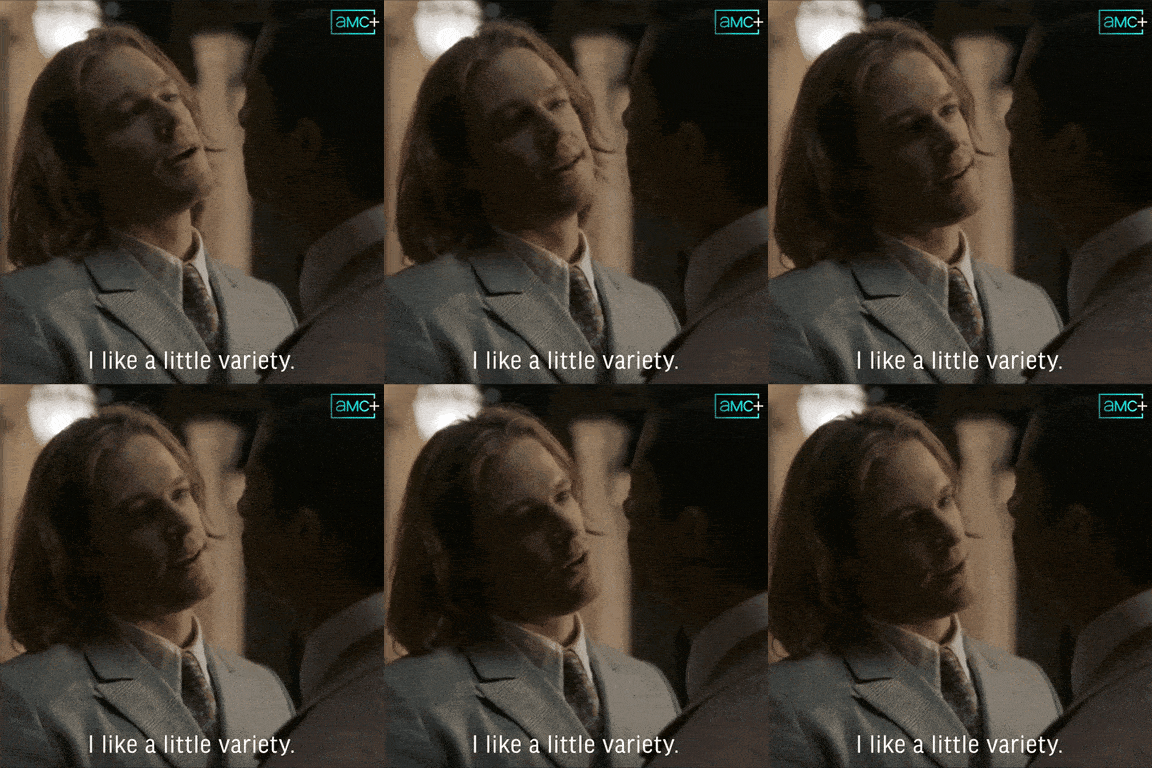
In the scene, I imagine Louis, lovable as he is, standing in for the legions of people who have reacted with skepticism or disdain when they felt threatened by their partner’s bi+ vibes. Real bi+ people are presented with a choice in moments like this: Avoid talking about sexuality entirely or endure questioning and dismissal by a whole lot of straight and gay people who don’t understand or believe us.
Inhabiting this identity—and talking about it—is a lifelong act of proving my own legitimacy, repeatedly reassuring partners that being potentially attracted to a person of any gender doesn’t negate that my love for them is whole, even if I don’t care what’s between their legs.
In the latest season of the series, rebranded The Vampire Lestat—which debuted in June—Lestat has become a modern vampire rock star, harnessing a gender-bending sex-positivity we’ve all been at least somewhat familiar with since the 1970s.
This season received a 98% Rotten Tomatoes score and continues to be one of AMC+’s most-watched shows. Finally, the modern mainstream audience is primed to accept an out bi lead. I only hope that acceptance goes beyond fictional TV characters, just as the show so poignantly offered in an episode of my life.
 | A guest post by
|
Asha, I too found Anne Rice's vampire books stimulating but for me from the other side. As a senior, bi-sexuality always got a bad rap in discussions and in practice. My husband (RIP) of 43 years started out calling himself a bi-sexual, was married, fell in love with me (a cis gay male), and eventually divorced his wife to spend the rest of his life with me. "It was easier", he would say. And in my days, when a man would say he was a bi-sexual, we would tell our own back story of who he REALLY was. Unfortunate that it seems so today although there are so many other combinations possible. Will it ever be possible for us to just we who are and love who we love without having to explain, defend, justify, etc. Thanks for shedding light on what a bi-sexual endures. Fondly, Michael
Oh Lestat 🖤 my patron saint of unruly desire.
I've learned that people mistake clarity for virtue. Lestat remains gloriously, rebelliously illegible.
"A lifelong act of proving my own legitimacy" hit me in the chest. I've often wondered whether it's easier not to mention I'm bisexual at all, simply because it invites conversations that begin with doubt rather than acceptance. Throughout my 20s, people treated my current partner as evidence of my "real" sexuality, or asked, "Have you actually dated [insert gender]?" depending on who I happened to be with. "How do you know?" became a question I heard far too often. As if coming out isn't a single moment but an endless negotiation with other people's certainty. Even now, living in Europe, I find that in some contexts it's either sexualised or brushed off with a dismissive, "whatever you say," leaving me feeling as though the complexity of my own experience is somehow a fiction of my own making. And that's before considering what it means to carry all of this while coming from a place where speaking about it at all can be dangerous.
I wonder if "I believe you" is sometimes enough.
Thank you for this beautiful piece. Huge fan of Anne Rice's vampires. AMC's Lestat has always made me feel less afraid of being "impossible to categorise." It helps, of course, that the series is so deliriously, decadently good.