

Mac Crane: "I thought it was the perfect opportunity to 'pervert' canon stories."
The author discusses 'Perverts,' their first short story collection, and why becoming a parent has given them a new perspective and focus in their writing.

Email us at queerloveprojectsub@gmail.com to take “The QLP Questionnaire.”
Plus, find out how to submit your original personal essay to The Queer Love Project.
We pay our contributors, so your subscription and support is valuable! Thanks for reading.
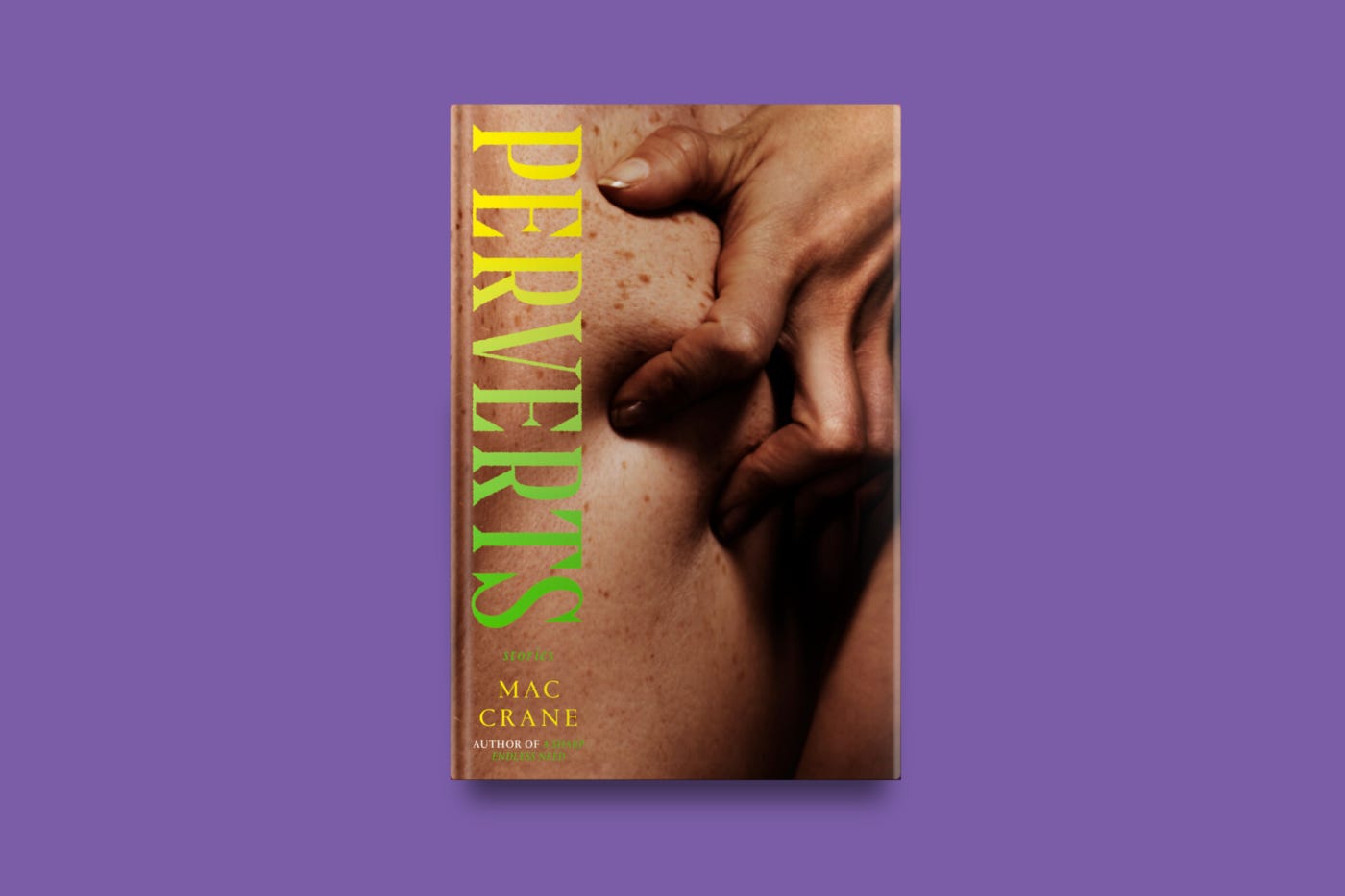
I recently had the opportunity to chat with Mac Crane, one of my all-time favorite authors, to discuss their debut short story collection Perverts. Mac’s first novel, I Keep My Exoskeletons to Myself (Catapult, 2023), is a groundbreaking work of abolitionist fiction following a queer mother raising her child after the death of her wife in a surveillance state.
Crane’s equally brilliant novel sophomore, A Sharp Endless Need, is a queer coming-of-age story set in 2004 Pennsylvania centering Mack Morrison, a star basketball player balancing grief over the loss of their father and their undeniable connection to their teammate Liv.
Check out the Queer Love Project’s Book Club interview about A Sharp Endless Need with Mac Crane as well.
While the threads of Mac’s obsessions—shame, desire, community, grief—run through each of their projects, all of them leave their own distinctive mark. Perverts is no exception. The collection of 17 stories reads like a revolution, resisting boundaries in every way and highlighting the most hidden truths of the human condition.
Here are some examples of the range of stories: A pregnant online sex worker blackmails their clients to come together for a party so they can anonymously sit among them. An ex-rugby player takes a job at a hunting ground where bigots are allowed to chase and attack queer people for a price. In a Peter Pan reimagining, a dyke newly settled into their domestic life sneaks away from their loving partner to go back to the sharp realities of nightlife. Characters scissor on front lawns and fuck their therapists. Crane isn’t interested in being apologetic or holding back in their work. And stepping into these stories feels like freedom.
There’s so much more I could say about this collection I’ve come to adore since I read it, but for now I’ll let you enjoy our discussion of Perverts below. If you’re looking for a more in-depth book review I highly recommend Mase An Hamberlin’s review over at Autostraddle, which in and of itself is a work of art.
Gen: I was so thrilled to see the announcement for this book. Anyone who knows me as a reader knows I’m a huge fan of your first two novels. I’ve also followed your short stories for a long time and know these pieces were written over a nine-year period. How did you come to realize these stories belonged together in a collection?
Mac: Oh gosh, was it realize or did I bully them into sharing the same room? Kidding. I always knew I wanted to write a collection, so I kept an eye on the things I was writing and publishing. I kept a list in a doc of my stories I liked until I could see the various themes repeating and see a book taking shape.
But I was sort of foolish early on in that I didn’t trust my own judgment of my work and felt like I needed external validation that a story was good before I could include it—that external validation as in, was it published by a respectable lit journal. Eventually, as I started to trust myself more and more, it was easier for me to figure out which stories belonged and which ones didn’t, regardless of publication or anything like that. I actually ended up putting one story in that I had never considered putting in the book ever: “Julie and the Butch.” I’m so glad I did because it’s so weird and adds texture to the collection in a way that I find satisfying.
All that to say: It was a process of course (wow, insightful, Mac) and, once I realized the themes of this book, I sat down and wrote a few stories to actually fit the collection, which was its own challenge, sort of writing on “assignment” for a fiction book, while still wanting freedom to play and experiment.
Gen: I love “Julie and the Butch.” So happy it made it in. Can you share a bit about the value you see in short story collections and what it’s been like for you to put one out? I feel like they are an art form that’s both essential to the literary landscape and deeply undervalued by the publishing industry and the world more broadly.
Mac: I think short story collections are magic, the best ones anyway. They have an immediate presence of character and situation, they’re transportive. I’ve always loved the short story, how it can feel like an entire world in 10-25 pages or so. Putting one out feels strange, especially in a landscape that is more interested in marketability and the flattening of a book so that it can easily be pushed on TikTok or Bookstagram or something. What’s the representation? What’s the genre? What else is it like?
Gen: It’s really disheartening to see the lack of imagination in the publishing world right now. We get the best kind of book magic when artists have the space to take risks and defy expectations. I know from talking to you that you’ve been deeply interested in New Narrative Movement authors (Robert Glück, Bruce Boone, Dennis Cooper, Kathy Acker, et. al). I can definitely see elements of that movement in the experimentation of your work and the way you embody both queer erotics and heartbreak on the page. What have you gotten from spending time with these authors?
Mac: I read Margery Kempe by my man Bob a few years ago and was like, well what the fuck! This is the best, most hilarious, most erotic most heartbreaking thing I’ve ever read!
I had read a bunch of Dennis Cooper’s books prior to that, but hadn’t realized he was part of that movement. Then I made this connection and fell headfirst into New Narrative authors. I’m not sure I could even articulate at first what I was getting from them, but I knew that each time I read their work, I felt alive and stimulated and curious and like I needed to take a picture of damn near every page because of a line or two that sparkled.
I got obsessed with the feeling of knowing I wouldn’t be disappointed by them. Even if the work wasn’t always a knockout. There would always be some sort of jewel that challenged or rearranged something for me.
Over the past few years I’ve been really disappointed by a few interconnected things: readers conflating character values, behaviors, perspectives with the author’s, which then leads to knee-jerk labels of problematic or canceling or callouts online, which has caused many contemporary authors to write from a place of fear or apprehension—which is never a good place to write from.
To be clear, I’m not blaming the authors or speaking poorly about this sort of response to a collective bad faith reading culture. But it has affected a lot of contemporary work, I think. Less risk-taking, more politically correct, socially acceptable characters; characters always acknowledging their privilege. Which often leaves less room for messiness, misbehavior, contradictions, and nuance—basically all of my favorite things.
I guess what I’m getting at is that every time I read New Narrative authors, I can tell they were and are deeply unconcerned with the reader labeling them anything at all: problematic, cruel, gross, pathetic, etc. In some ways, the New Narrative Movement loves being “pathetic.” Some of them anyway. Authors like Glück, Cooper, Kraus (I Love Dick); they wrote into the very things that other people shy away from. Oh, I seem like a yearning, pathetic loser? Oh well, I’ll turn it into performance art, or queer theory, or erotic fantasy, or all three.
Gen: That was one of the many things I loved about Kathy Acker; she did not give a fuck what people thought and it made from some of the most earth-shattering work I’ve ever seen.
Mac: Exactly. I’m also very interested in the New Narrative Movement’s commitment to plagiarizing each other. You made me think of it because Acker, I believe, would just copy entire sections from books and put them in hers.
Gen: I know. Such an insane move.
Mac: They didn’t see ownership of work; they shared freely; they existed in this collective space. God, one of them, I forget who, published his friend’s poem as his own once because he found it in his notebook and thought he’d written it. And the friend was like: “Whatever.”
Gen: I love that collective creation and support of an idea in an arts culture that’s hyper-focused on the individual. I think that leads into my next question, which is about the exact opposite of boundary-pushing work.
As someone who is staunchly anti-AI, one of my favorite stories from your collection is “I Have No Records of Your Ass.” In that story, we see the ways in which AI serves as a tool of exploitation, enhances loneliness, and moves people away from care and toward cruelty. Can you share a bit about that story and how you see fiction being impacted by the onslaught of AI writing?
Mac: The exact opposite indeed! When I wrote it, we weren’t so inundated. What’s funny is, I thought less about AI as we know it when writing that and more about SmarterChild from AIM. I was thinking about our human capacity for cruelty. What does it look like when we are interacting with something that doesn’t have a “soul”?
When I was a gay, closeted, angry adolescent, I used to be super mean to SmarterChild for no reason beyond that I was full of rage and didn’t understand my rage. I would be like, fuck you! And it would respond with, Please use kind language with me. I am a machine here to help you find information. I do not appreciate your language.
Given that the AI overlords are obsessed with making AI seem human, I wanted to turn that on its head and have a human attempt to mimic AI. I wrote a character who has never given themself permission to try on new roles or identities. Ultimately, the mask of being an alleged machine frees this person.
Gen: So Perverts is dedicated to “those who identify with the epigraphs.” The two epigraphs you selected were Denis Johnson’s line from Jesus’ Son: “Talk into my bullet hole. Tell me I’m fine.” And George Saunders’ line from Lincoln in the Bardo: “We were perhaps not so unlovable as we had come to believe.”
Why did you select those two epigraphs for this collection (aside from going after me personally)?
Mac: I’m a huge epigraph slut, always have been. It’s so hard for me to narrow it down. But I also view them as an art form. What are these particular epigraphs doing together that they could never do separately? They feel like poetry. “Talk into my bullet hole. Tell me I’m fine,” really struck me. It stopped me in my tracks. It felt perfect for so many of the characters in this collection because many of them are going through psychological or emotional emergencies. They’re in pain. They know they’re metaphorically bleeding out but they also want to be told that they will live through it, that they will be OK, even if it is delusional. It’s a sort of hopeful delusional space to live in, hopeful because it’s asking for care from someone.
Gen: I read part of the collective tissue of this collection as an examination of how we carry the love/lack of love we receive in childhood through our lives. As someone who has followed you and your work for a long time, I get the sense you’re often thinking of your roles as a parent, writer, and community member together.
Do you feel like becoming a parent has impacted the way you think about these stories and your art overall?
Mac: Parenting has made my world feel way bigger while also, at times, made it feel much smaller. That tension is interesting to me. It’s not that I was selfish before I had kids, but I do think, especially when coming to my queerness and transness (also ongoing, of course), I was a bit self-focused, self-interested. I was in a lot of pain and was looking inward at that pain a lot. Parenting has refocused me on not just my children but everyone: my children’s friends; all the children of our community; the parents and non-parents of my community.
I would say that parenting has made me examine my characters from new lenses. Like, as their parents for instance. What does this character want? What do they need? What did “I” not give them? What did I? Can the distance be collapsed?
Gen: Throughout this collection, you’ve continued to reimagine stories including The Magic School Bus, The Catcher in the Rye, and Peter Pan (thank you for fulfilling my dream of centering a dyke in the Peter Pan universe). What do you think draws you to reimaginings as a writer?
Mac: Oh gosh, I think some of it is the same thing that attracts me to the New Narrative Movement, that borrowing from and being inspired by others. Speaking of parenthood, I’ve re-encountered some of these childhood stories again as an adult and parent. My five-year-old loves The Magic School Bus. Watching these things with these new, different eyes leaks into my work. I also love the idea of performance and role play (in and out of the bedroom), which is obviously all over this collection, and some of those particular stories felt like great territory for exploring performance. Especially camp icon Ms. Frizzle. Plus, since the book is called Perverts, I thought it was the perfect opportunity to “pervert” canon stories.
Perverts is out now. Be sure to pick up a copy and/or request it at your local library.
Looking for more books to read? Visit the Queer Love Project’s curated shelves at Bookshop.org for more ideas for your TBR list!
Plus, share your favorites in the comments and we’ll add them to our queue!
 | A guest post by
|